logo
Chongqing Gold Mechanical & Electrical Equipment Co.,Ltd
Дом > Продукты > Геофизическая аппаратура исследования >
Hydraulic Conductivity Meter Porosity Mapping Equipment
  • Hydraulic Conductivity Meter Porosity Mapping Equipment
  • Hydraulic Conductivity Meter Porosity Mapping Equipment
  • Hydraulic Conductivity Meter Porosity Mapping Equipment
  • Hydraulic Conductivity Meter Porosity Mapping Equipment
  • Hydraulic Conductivity Meter Porosity Mapping Equipment
  • Hydraulic Conductivity Meter Porosity Mapping Equipment

Hydraulic Conductivity Meter Porosity Mapping Equipment

Место происхождения Чунцин, Китай
Фирменное наименование GOLD
Сертификация CE, ISO
Номер модели WDA-1A
Детали продукта
индивидуальная поддержка:
OEM
тип:
Детектор воды
Номер модели:
WDA-1
Название продукта:
Суперцифровый счетчик постоянного тока и IP
Использование:
Детектор золота
Рабочая температура:
-10 ℃ ~+50 ℃, 95%RH
Температура хранения:
-20 ℃ ~+60 ℃
Вес хоста:
4.4kg
Характер продукции
Hydraulic Conductivity Meter Porosity Mapping Equipment
Eco-Sensitive Subsurface Assessment and Cultural Heritage Preservation System

Infrastructure development, mining, and renewable energy projects increasingly face regulatory and public expectations to avoid, minimize, or mitigate impacts on sensitive environments and cultural heritage. The challenge is that traditional subsurface investigation often requires invasive techniques (trenching, drilling, test pitting) that themselves cause the very disturbance the project seeks to avoid.

Our Eco-Sensitive Subsurface Assessment and Cultural Heritage Preservation System provides a non-invasive, high-resolution alternative, using advanced geophysics to characterize the subsurface with minimal environmental footprint. This platform enables project proponents to identify sensitive features (archaeological sites, paleontological resources, critical habitats, wetlands) early in the planning process, allowing route selection or design modifications that avoid impacts entirely.

Integrated Technology Platform

The system integrates three complementary non-invasive technologies selected for their minimal ground disturbance: capacitively coupled resistivity (no ground contact required), ground-penetrating radar, and magnetic gradiometry. Deployed from portable, hand-towed carts or small unmanned ground vehicles, these sensors acquire data while leaving no trace.

  • Archaeological Prospection: Identifies buried structures (walls, foundations, hearths), features (middens, pits, ditches), and artifacts at depths up to 2-3 meters
  • Magnetic Gradiometry: Sensitive to fired clay (kilns, hearths) and magnetic minerals concentrated by human activity
  • Ground-Penetrating Radar: Images discrete objects and stratigraphy
  • Resistivity Mapping: Maps earthworks, ditches, and buried organic remains
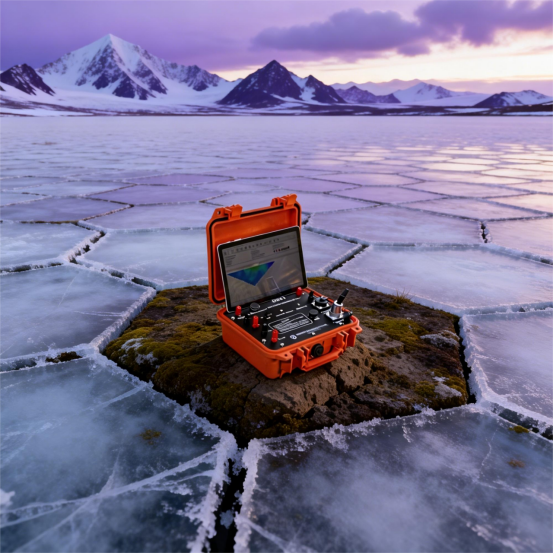
Eco-sensitive subsurface assessment equipment in field operation Close-up view of geophysical sensors and data collection Field deployment of non-invasive assessment platform Data visualization and analysis interface
Technical Specifications
Application Primary Sensor Depth Range Feature Detection Environmental Benefit
Archaeological Prospection GPR (200-900 MHz) + magnetic gradiometer GPR: 0-2m; Magnetics: 0-1.5m Walls, pits, hearths, artifact concentrations Locates buried sites without excavation; guides avoidance
Paleontological Resources GPR (100-400 MHz) + capacitively coupled resistivity 0-4m; fossil-specific contrast depending on matrix Fossil horizons, individual large bones Prevents accidental destruction; enables non-invasive assessment
Wetland Delineation Resistivity (capacitive or galvanic) with automated inversion 0-5m; 0.5m vertical resolution Wetland boundaries, depth to saturation, groundwater discharge zones Supports regulatory compliance; avoids wetland impacts
Critical Root Zone Mapping GPR (400-900 MHz) + soil conductivity 0-1.5m Coarse root distributions; soil compaction zones Protects sensitive tree root systems during construction
Contamination Assessment Resistivity + IP with depth-specific inversion 0-10m; detects LNAPL, DNAPL, leachate plumes Plume boundaries, source zones Prioritizes remediation; documents conditions pre-development
Workflow and Methodology

The platform's environmental sensitivity mapping workflow begins with desktop review of existing data (aerial imagery, LiDAR, historic maps, known site records). The field survey is then targeted to areas of highest potential, with adaptive survey design that intensifies coverage where initial results suggest buried features.

For large corridors (pipelines, transmission lines, roads), the system can survey tens of kilometers per day, identifying avoidance areas early enough to reroute before detailed engineering. All results are delivered in spatially referenced formats that plug directly into GIS-based environmental impact assessments and routing optimization tools.

Geophysical data visualization and mapping results Field team operating assessment equipment Integrated data analysis and reporting interface
Regulatory Compliance and Quality Assurance

Designed for environmental consultants, cultural resource managers, and infrastructure developers, the platform prioritizes regulatory defensibility and peer review. Survey methodologies follow published standards (EAC Guidelines for Geophysical Archaeology, ASTM D6432 for GPR). Raw and processed data are archived in open formats for independent review.

The system's uncertainty visualization highlights areas where geophysical response was ambiguous, allowing cultural resource professionals to recommend targeted ground truthing rather than blanket excavation.

Key Benefits
  • Non-invasive subsurface characterization with minimal environmental footprint
  • Early identification of sensitive archaeological and paleontological resources
  • Precise wetland delineation and ecosystem mapping
  • Regulatory compliance and peer-reviewed methodologies
  • Adaptive survey design for efficient large-area coverage
  • GIS-compatible data formats for seamless integration
Summary

The Eco-Sensitive Subsurface Assessment and Cultural Heritage Preservation System enables project proponents to know what lies beneath without disturbing what lies beneath. It replaces the destructive uncertainty of "dig and see" with the non-invasive clarity of advanced geophysics, allowing sensitive resources to be identified, mapped, and avoided early in the planning process. It is the essential tool for responsible development in a world that increasingly demands both progress and preservation.

Порекомендованные продукты

Свяжитесь мы в любое время

0086-159-2263-6015
Техническое здание 1F, промышленный парк Лонгсин, район Наньань, Чунцин, Китай
Отправьте ваше дознание сразу в нас